Beginner Skate Coaching Cheat Sheet
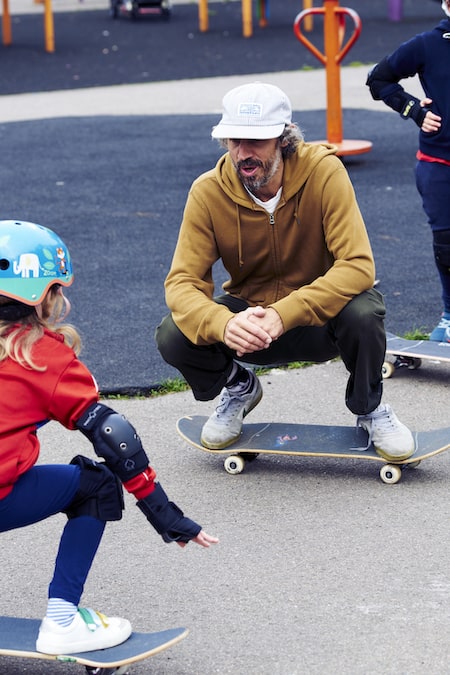
This cheatsheet is for running beginner group classes with students of a similar level with reference to our lesson plan.
For coaches; these are the instructions you will say the most to students during a beginner class, in order of frequency and importance from 1 – 9, and reasoning behind them.
For students, these are some of the instructions you will hear a lot in our classes and the reason you hear them.
1. “Turn your front foot”
Scenario: You are teaching students to stand on their skateboard, push their skateboard or carve their skateboard
Toes and heels must be over the wheels to be able to correct your balance whilst rolling, and to carve with both trucks effectively. If the front foot isn’t positioned correctly, it’s like trying to steer a bike with one hand.
2. “Put your feet either side of the board”
Scenario: When learning to stand on their skateboard, students don’t start in their push stance
Students should be consistently getting on the skateboard the same way, i.e. via the push stance. If they are struggling, encourage them to reset, standing with legs apart, with the boards between their legs, before putting the correct front foot on the board.
3. “What is your Stance Bob/Andrew/Sally?”
Scenario: You suspect the student is switching from regular to goofy stance
When deciding stance, regular or goofy, have the student put their favoured foot on the back. When students keep changing their stance it slows learning and is a health and safety risk. Do not permit students to roll along until you have made a note of their stance (regular or goofy) . Have a card you can refer to, or a whiteboard with students names and their stance written on it so you can easily refer to it from across the skatepark.
4. “Bend your knees”
Scenario: The student is almost on tippy toes.
When your centre of gravity is high it is a health and safety risk. Knees should be bent to enable quickly dropping down into safe stance to stabilise or to control their fall.
5. “Don’t jump off your skateboard”
Scenario: student is losing balance and jumps or steps off their skateboard
Jumping off short circuits the learning process, and is a major health and safety risk because skateboards are designed to stay under your feet. Drill falling; assuming safe stance (squatting) and stabilisation with hands.
6. “Toes and heels over the wheels”
Scenario: When carving the student isn’t turning the front foot, or favours the back foot too heavily
The trucks are the turning system. If you are only using your back foot, you are only using half of the system. Related to (1) “Turn your front foot”
7. “Don’t lean back”
Scenario: Student is rolling in flat bank and falls backward
The student wants to control (slow) their speed in this scenario. As such it is unintuitive to lean forward. Encourage them to hold the nose in safe stance to keep weight over the nose.
8. “Was your fall good or bad?“
Scenario: the student falls over and looks discouraged
Mistakes are a function of the learning process, and falling is what happens when you make a mistake. If you’re not making mistakes you are not learning. Falling needs to be encouraged & practiced to get better. Ask: “Did you get your hands down first?“
9. “Carve don’t kick-turn”
Scenario: when carving cones students kick-turns to get round the cones
This is indicative that either the truck needs loosening (or replacing) or the student needs to practice their carve.
If you’re interested in skate coaching please see our coach training services.